
Georgia Care Innovators President and CEO, Dr. Kathleen Benton, challenges conventional thinking about healthcare in a new article published by Swaay.Health.
Healthcare has become remarkably sophisticated at diagnosing and treating diseases. We have specialists for nearly every organ, condition, and medical challenge. Yet for people living with multiple chronic conditions, navigating the healthcare system can be an exhausting and fragmented experience.
What if the problem isn’t a lack of compassion among healthcare professionals, but the way we’ve organized healthcare itself?
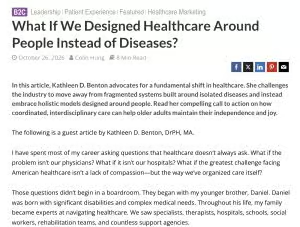 That’s the question Dr. Kathleen Benton, President and CEO of Georgia Care Innovators, explores in her newly published article for Swaay.Health, “What If We Designed Healthcare Around People Instead of Diseases?”
Drawing on her personal experiences growing up with her younger brother, Daniel, who lived with significant disabilities and complex medical needs, Kathleen describes a healthcare system in which dedicated professionals worked tirelessly to address individual conditions, but no one was responsible for coordinating his care as a whole person. As Kathleen writes, “The healthcare system wasn’t coordinated. My parents were.”
That experience helped shape her career in clinical ethics, public health, hospice, palliative care, and healthcare innovation. It also informed her conviction that healthcare must do more than treat individual diagnoses. It must recognize the person behind them.
A different way to think about healthcare
In the article, Kathleen challenges healthcare leaders to consider what might happen if we stopped organizing care primarily around diseases and institutions and instead designed services around the lives people actually lead. For older adults living with multiple chronic conditions, that means looking beyond medical treatment to address transportation, nutrition, mobility, social connection, caregiver support, and the activities that give life meaning.
Kathleen points to PACE (Program of All-Inclusive Care for the Elderly) as one example of how coordinated, interdisciplinary care can help older adults remain independent and connected to their communities. She also shares the years-long effort to bring PACE to Georgia, an initiative driven by the recognition that the state’s growing older adult population needed more options for comprehensive, person-centered care.
But her message extends well beyond any one program.
The real opportunity, Kathleen argues, is to rethink what healthcare is designed to accomplish. Rather than simply helping people live longer, we should be helping them continue living lives filled with purpose, independence, connection, and joy.
It’s a philosophy at the heart of Georgia Care Innovators and our commitment to identifying unmet community needs and developing compassionate, innovative solutions.
We invite you to read Kathleen’s article and consider her challenge to the healthcare industry: What if we started designing healthcare around people instead of diseases?
